This will have to be very brief, but I had several conversations at the Charleston SMH that gave me reason to feel more optimistic about military history's future as an academic field--at least intellectually-- and the organization's interest in helping the field to expand, both intellectually and in terms of the number of academic positions. I'm currently digging myself out of the usual post-conference backlog of chores, but in coming days I'll have a number of posts (with photos!) concerning the annual meeting.
For the present, I'd just like to offer a public word of thanks to Prof. Jennifer Speelman of The Citadel, who did a wonderful job of organizing the conference.

Blog Them Out of the Stone Age: Toward A Broader Vision of Military History and National Security Affairs
Monday, February 28, 2005


Thursday, February 24, 2005
The Charleston SMH: A Reconnaissance
I leave in a few hours for the annual meeting of the Society for Military History.
I've looked over the program with as much care as I could. If I counted correctly, there are forty-two sessions. Of these, fifteen deal directly with the conference theme, "The Rise of the Military Profession."
Nineteen sessions, by my count, are exclusively concerned with the United States military experience.
Eleven sessions deal exclusively with the European military experience.
Seven sessions have papers that involve U.S. and European subjects.
One deals with the Canadian military experience.
Two sessions deal with the South African military experience, and although these deal extensively with British and Boer actors, I'll accept them as non-European.
One session deals with Egypt.
One session deals with a topic that seems to have race at its core.
No sessions, as far as I can tell, involve women or gender.
No sessions are devoted exclusively to non nation-state actors, though I counted three papers that seemed to examine their subjects principally through the lens of non nation-state actors.
It also seemed to me that terms current in the defense establishment were frequently used to describe sessions that dealt with other historical periods; e.g., "Amphibious Warfare in the Early Modern World;" "The Continental Army: Insurgent Peace-Keepers?;" "Insurgency and Counterinsurgency in Southern Africa, 1900-1902;" "Counter-Insurgency from Cuba to Castile . . . 1895-1936;" "Asymmetrical Warfare during the American Revolution's Southern Campaign;" "Professionalism and Peace Operations [in the U.S., 1830-1860]."
Here is an excerpt from Tom Bruscino's post, which I highlighted yesterday:
Look at the program for yourself. You will indeed see some attention to social life, cultural issues, memory, and politics. But if these concerns honestly strike you as being as much a part of the field as European-style command, military institutions, strategic-policymaking, and warfare, I would love to be enlightened.
The problem is not that the papers that will be presented are not good papers. In my experience, most of the papers given at the SMH display the same quality you see at other major conferences.
The problem is not that the presenters should quit doing research on these topics, which plainly interest them, and instead research topics that do not.
The problem is not one of achieving academic cachet. Military history will be, for a long time, a bastard child of academe. For political reasons, not intellectually-defensible ones.
The problem is that military historians have themselves painted the field into a corner that is far too small and is intellectually indefensible. And they have done it for political reasons. They have made little effort to reach out to the many historians who examine war and military affairs through the lens of gender, race, and class; from non-European perspectives; or from the perspective of counterhegemonic actors. That is why so few of these historians present their work at the SMH, or are even aware of its existence.
They say that eighty percent of people in academe are Democrats or in some way politically left-of-center. That argues for some form of political gate-keeping--in my view most likely an accidential gate-keeping whereby most people who self-select into academe are already left of center to begin with.
Within the field of military history, I would argue that a similar form of gate-keeping prevails, perhaps accidental, perhaps not. The gate-keeping takes this form: Be a military historian who deals with questions, agendas and conceptual frameworks congenial to the defense establishment, or do not call yourself a military historian. We don't don't want your scholarship, don't want your participation, don't want your voice, don't want you.
Because if we did want you, we'd make an effort as an organization to reach out to you and include you.
When I attended the last SMH, I looked very hard for evidence that anyone--be they leadership or rank-and-file--wanted to enlarge the tent. I didn't see much. I'll be looking again at the Charleston SMH. I'll let you know what I find.
I've looked over the program with as much care as I could. If I counted correctly, there are forty-two sessions. Of these, fifteen deal directly with the conference theme, "The Rise of the Military Profession."
Nineteen sessions, by my count, are exclusively concerned with the United States military experience.
Eleven sessions deal exclusively with the European military experience.
Seven sessions have papers that involve U.S. and European subjects.
One deals with the Canadian military experience.
Two sessions deal with the South African military experience, and although these deal extensively with British and Boer actors, I'll accept them as non-European.
One session deals with Egypt.
One session deals with a topic that seems to have race at its core.
No sessions, as far as I can tell, involve women or gender.
No sessions are devoted exclusively to non nation-state actors, though I counted three papers that seemed to examine their subjects principally through the lens of non nation-state actors.
It also seemed to me that terms current in the defense establishment were frequently used to describe sessions that dealt with other historical periods; e.g., "Amphibious Warfare in the Early Modern World;" "The Continental Army: Insurgent Peace-Keepers?;" "Insurgency and Counterinsurgency in Southern Africa, 1900-1902;" "Counter-Insurgency from Cuba to Castile . . . 1895-1936;" "Asymmetrical Warfare during the American Revolution's Southern Campaign;" "Professionalism and Peace Operations [in the U.S., 1830-1860]."
Here is an excerpt from Tom Bruscino's post, which I highlighted yesterday:
Military historians have at times been far too caught up in the traditional end of our field--discussions of battles from the perspective of generals. We have not done the best job in explaining how the importance of military affairs extends far beyond the battlefield. But the effort is underway, and has been for twenty-five years, to broaden military history to include all manner of discussions on race, class, gender, social life, cultural issues, memory, and politics.
Look at the program for yourself. You will indeed see some attention to social life, cultural issues, memory, and politics. But if these concerns honestly strike you as being as much a part of the field as European-style command, military institutions, strategic-policymaking, and warfare, I would love to be enlightened.
The problem is not that the papers that will be presented are not good papers. In my experience, most of the papers given at the SMH display the same quality you see at other major conferences.
The problem is not that the presenters should quit doing research on these topics, which plainly interest them, and instead research topics that do not.
The problem is not one of achieving academic cachet. Military history will be, for a long time, a bastard child of academe. For political reasons, not intellectually-defensible ones.
The problem is that military historians have themselves painted the field into a corner that is far too small and is intellectually indefensible. And they have done it for political reasons. They have made little effort to reach out to the many historians who examine war and military affairs through the lens of gender, race, and class; from non-European perspectives; or from the perspective of counterhegemonic actors. That is why so few of these historians present their work at the SMH, or are even aware of its existence.
They say that eighty percent of people in academe are Democrats or in some way politically left-of-center. That argues for some form of political gate-keeping--in my view most likely an accidential gate-keeping whereby most people who self-select into academe are already left of center to begin with.
Within the field of military history, I would argue that a similar form of gate-keeping prevails, perhaps accidental, perhaps not. The gate-keeping takes this form: Be a military historian who deals with questions, agendas and conceptual frameworks congenial to the defense establishment, or do not call yourself a military historian. We don't don't want your scholarship, don't want your participation, don't want your voice, don't want you.
Because if we did want you, we'd make an effort as an organization to reach out to you and include you.
When I attended the last SMH, I looked very hard for evidence that anyone--be they leadership or rank-and-file--wanted to enlarge the tent. I didn't see much. I'll be looking again at the Charleston SMH. I'll let you know what I find.
Wednesday, February 23, 2005
Military History and the Academy
In a comment on my previous post, Tom Bruscino asks me to take a look at the above post on Rebunk. I encourage readers of this blog to do the same.
Monday, February 21, 2005
The Charleston SMH
The flagship organization for military historians, at least those who work in North America, is the Society for Military History. I sketched some background about the SMH in an entry composed after attending its last annual meeting, which was held last May in Bethesda, Maryland.
The next meeting will be held later this week in Charleston, South Carolina. I'm looking forward to it. The meetings always give me a chance to meet old friends and make new ones. I get an opportunity to see what's going on in the field. And because I've somehow managed never to visit Charleston before now, I'll finally get to visit Fort Sumter, the only significant Civil War battle site I have yet to see.
I've not yet taken time to look systematically at the conference program. If I had to guess, however, I imagine that it will look similar to last year's program. The question I have for you--and for that matter, me--is this. Supposing that I were a history department or college dean willing to consider creating a military history position? Suppose that I knew the most likely objections I would receive would have to do with protests about the lack of intellectual vigor in the field; that people would wonder if military historians had anything of consequence to say to those in other fields; that they would wonder if military history were in meaningful conversation with those in other fields. Would the program, overall, help or hinder my case?
The next meeting will be held later this week in Charleston, South Carolina. I'm looking forward to it. The meetings always give me a chance to meet old friends and make new ones. I get an opportunity to see what's going on in the field. And because I've somehow managed never to visit Charleston before now, I'll finally get to visit Fort Sumter, the only significant Civil War battle site I have yet to see.
I've not yet taken time to look systematically at the conference program. If I had to guess, however, I imagine that it will look similar to last year's program. The question I have for you--and for that matter, me--is this. Supposing that I were a history department or college dean willing to consider creating a military history position? Suppose that I knew the most likely objections I would receive would have to do with protests about the lack of intellectual vigor in the field; that people would wonder if military historians had anything of consequence to say to those in other fields; that they would wonder if military history were in meaningful conversation with those in other fields. Would the program, overall, help or hinder my case?
Saturday, February 19, 2005
A Strategy of Juxtaposition
In a previous post, I wrote that I didn't "have time to cover the issues that need covering and at the same time explain to readers the reasoning that underpins my selection and weighting of issues." For example, "readers might wonder why a blog that has spent so much time engaging with the ideas of Tom Barnett in The Pentagon's New Map has of late spent so much time engaging with the ideas of Ward Churchill in On the Justice of Roosting Chickens." The answer, I said, was "of course, obvious."
Well, maybe not so obvious.
Jonathan Dresner wrote a comment on the post in which he essentially deduced that I was thinking in terms of blowback. The term, originally coined by the CIA to refer to the unintended adverse consequence of a covert operation, has in recent years been used in connection with the unintended consequences of American foreign policy. Churchill was just one of many commentators who viewed the September 11 as an instance of blowback. (Most, by the way, managed to express their view with much greater coherence and persuasive power.)
I gather than Jonathan thought I believed that Barnett's national security vision, if implemented, would result in a lot of blowback, and that this accounted for my interest in Churchill's "roosting chickens" essay. That's a reasonable inference. In fact, however, my reasons for engaging with both Barnett and Churchill derive from a completely different source.
If you go back to this blog's first entry, from December 2003, you'll find that it begins by juxtaposing the cover of a history of U.S. Army counterinsurgency operations with a photo of Hondurans living in a trash dump. The early entries juxtaposed postcolonialism and military history and asked what relationship might be found between the two. The eventual logo of the blog, first created in April 2004, juxtaposed portraits of Che Guevara and Robert E. Lee, a relationship explained in Polarities of Power. Juxtaposition is, in short, the basic strategy that informs the blog. It's nothing sophisticated--nothing so systematic, for example, as a dialectic (thesis, antithesis, synthesis). It's just a matter of taking two seemingly disparate things, postulating a relationship between the two, and working from both ends to eventually weave a thread of connection. I have found it a useful tool by which to get beyond the traditional intellectual boundaries of military history, and to begin to create a new, more expansive map of the field. That's pretty much all there is to it.
Not long ago a student in my History 151 class who is also an aspiring web designer took a look at this blog and, seeing that I plainly needed it, came forward to offer her assistance. One of her first assignments has been the creation of a Flash presentation to animate the logo. The presentation is still a work in progress, but it suggests some of what this expanded map involves: an equal emphasis on the hegemonic and counterhegemonic use of force. Check it out. To view the presentation, you will need Macromedia Flash Player, which can be downloaded for free.
Well, maybe not so obvious.
Jonathan Dresner wrote a comment on the post in which he essentially deduced that I was thinking in terms of blowback. The term, originally coined by the CIA to refer to the unintended adverse consequence of a covert operation, has in recent years been used in connection with the unintended consequences of American foreign policy. Churchill was just one of many commentators who viewed the September 11 as an instance of blowback. (Most, by the way, managed to express their view with much greater coherence and persuasive power.)
I gather than Jonathan thought I believed that Barnett's national security vision, if implemented, would result in a lot of blowback, and that this accounted for my interest in Churchill's "roosting chickens" essay. That's a reasonable inference. In fact, however, my reasons for engaging with both Barnett and Churchill derive from a completely different source.
If you go back to this blog's first entry, from December 2003, you'll find that it begins by juxtaposing the cover of a history of U.S. Army counterinsurgency operations with a photo of Hondurans living in a trash dump. The early entries juxtaposed postcolonialism and military history and asked what relationship might be found between the two. The eventual logo of the blog, first created in April 2004, juxtaposed portraits of Che Guevara and Robert E. Lee, a relationship explained in Polarities of Power. Juxtaposition is, in short, the basic strategy that informs the blog. It's nothing sophisticated--nothing so systematic, for example, as a dialectic (thesis, antithesis, synthesis). It's just a matter of taking two seemingly disparate things, postulating a relationship between the two, and working from both ends to eventually weave a thread of connection. I have found it a useful tool by which to get beyond the traditional intellectual boundaries of military history, and to begin to create a new, more expansive map of the field. That's pretty much all there is to it.
Not long ago a student in my History 151 class who is also an aspiring web designer took a look at this blog and, seeing that I plainly needed it, came forward to offer her assistance. One of her first assignments has been the creation of a Flash presentation to animate the logo. The presentation is still a work in progress, but it suggests some of what this expanded map involves: an equal emphasis on the hegemonic and counterhegemonic use of force. Check it out. To view the presentation, you will need Macromedia Flash Player, which can be downloaded for free.
Wednesday, February 16, 2005
Away from the Blog
I doubt that I'll have the opportunity to post further until Saturday, February 19. Look for a new post then.
Sunday, February 13, 2005
(E) "Little Eichmanns" - Part VI
I continue to wrestle with the issue of whether the "little Eichmanns" metaphor can be made coherent. As I have said, a major problem with the Ward Churchill essay is that the essay fails to deploy the metaphor effectively, at least as an aid to analysis. As an aid to incitement, it has proven to be quite effective.
This video does a better job of explaining Churchill's basic perspective in two minutes than Churchill does in 20 pages. The organization highlighted in this video is the Project for the New American Century (PNAC). If you check out the signatories to PNAC's Statement of Principles , then read PNAC's open letter to President Clinton dated January 26, 1998, you can see how so many people can regard it as reasonable to believe that the Bush administration had a pre-9/11 agenda to attack Iraq. The video's argument that the underlying rationale is a sort of corporatist neo-fascism is not, in my opinion, sustained by the PNAC site, but then it wouldn't be, would it?
Continue to next page (link not yet active)
Update, March 1: For a different perspective on the Churchill controversy--and me, for that matter-- see Churchill's Defenders from the Feb. 28 edition of FrontPage magazine.
This video does a better job of explaining Churchill's basic perspective in two minutes than Churchill does in 20 pages. The organization highlighted in this video is the Project for the New American Century (PNAC). If you check out the signatories to PNAC's Statement of Principles , then read PNAC's open letter to President Clinton dated January 26, 1998, you can see how so many people can regard it as reasonable to believe that the Bush administration had a pre-9/11 agenda to attack Iraq. The video's argument that the underlying rationale is a sort of corporatist neo-fascism is not, in my opinion, sustained by the PNAC site, but then it wouldn't be, would it?
Continue to next page (link not yet active)
Update, March 1: For a different perspective on the Churchill controversy--and me, for that matter-- see Churchill's Defenders from the Feb. 28 edition of FrontPage magazine.
Soldiers in Iraq: Hang On to Your Humanity
An open letter to GIs in Iraq.
Found this link in a syllabus in an English composition course whose thematic focus was "Making Peace, Making War."
The letter was written in November 2003 by a Vietnam veteran who served in the 173rd Airborne Brigade. It is posted on the Bring Them Home Now web site. BTHN describes itself as "a campaign of military families, veterans, active duty personnel, reservists and others opposed to the ongoing war in Iraq and galvanized to action by George W. Bush's inane and reckless challenge to armed Iraqis resisting occupation to 'Bring 'em on.'"
Found this link in a syllabus in an English composition course whose thematic focus was "Making Peace, Making War."
The letter was written in November 2003 by a Vietnam veteran who served in the 173rd Airborne Brigade. It is posted on the Bring Them Home Now web site. BTHN describes itself as "a campaign of military families, veterans, active duty personnel, reservists and others opposed to the ongoing war in Iraq and galvanized to action by George W. Bush's inane and reckless challenge to armed Iraqis resisting occupation to 'Bring 'em on.'"
Saturday, February 12, 2005
Clearing the Net
An advantage of blogs: They can be about anything.
A problem with blogs: They can be about anything.
Between the Ward Churchill imbroglio and the more recent "Gooney Left" affair, the focus of this blog has of late drifted toward present-day politics. That's not necessarily divorced from its main subject--as Clausewitz famously said--"war is a continuation of politics by other means." But it does threaten to dilute the main thrust of War Historian.
Consequently it has seemed best to move political discussions to another blog, The Ohio Twenty-first, so-named simply because I happen to live in the 21st District of the Ohio House of Representatives and all politics is, supposedly, local. Feel free to drop by.
I'll continue to pursue the Ward Churchill matter on War Historian, as well as other political issues that seem more or less directly related to military affairs. But all other personal political views go to The Ohio Twenty-first.
A problem with blogs: They can be about anything.
Between the Ward Churchill imbroglio and the more recent "Gooney Left" affair, the focus of this blog has of late drifted toward present-day politics. That's not necessarily divorced from its main subject--as Clausewitz famously said--"war is a continuation of politics by other means." But it does threaten to dilute the main thrust of War Historian.
Consequently it has seemed best to move political discussions to another blog, The Ohio Twenty-first, so-named simply because I happen to live in the 21st District of the Ohio House of Representatives and all politics is, supposedly, local. Feel free to drop by.
I'll continue to pursue the Ward Churchill matter on War Historian, as well as other political issues that seem more or less directly related to military affairs. But all other personal political views go to The Ohio Twenty-first.
Loyal Subversive
is a new blog kept by a mobilized member of the Marine Corps Reserve with nearly 20 years combined active and reserve service. He is also an advanced PhD student in military history.
"The Gooney Left" - Part VI
This is the conclusion of "The Gooney Left" entry. If there are further developments, I'll report them under a separate thread.
About ten people have so far accepted the invitation to the "Gooney Left" open house. I'll repeat the invitation in a few days, shorn of the "Gooney Left" label, so that people can come who may not necessarily want to make an implicit political statement.
Ninety percent of the people who read my email in response to Prof. Watts approved of it. Three or four individuals thought it was foolish or futile to engage with him. In at least one instance I had the impression that the individual considered my reply the moral equivalent of Prof. Watts's original post.
I suspect this last appraisal was the tip of an iceberg. There is, within academe, a significant current of opinion that values decorum over free exchange. I do not say that adherents to this view deny the value of free exchange; I merely say that they think there is an appropriate time and place for it. Usually it is some other time, some other place.
For a time the faculty and grad student list servs were swamped with exchanges concerning the Day of Remembrance/Malkin book affair. A handful of people accounted for all of them. Eventually the department chair quite sensibly directed that the exchange be moved elsewhere, and offered to create a separate list serv for the purpose.
His email crossed with mine, in which I stated that I had already created such a list serv:
http://groups-beta.google.com/group/OSU-History
I placed Prof. Watts's email address on it and my own. I invited others to "opt in" on the exchange and within a few minutes had five takers. At 3:05 p.m. I sent the following email to the six other members on the list:
I have so far heard nothing from Prof. Watts, and gotten only a single response from anyone else. This came from a graduate student:
About ten people have so far accepted the invitation to the "Gooney Left" open house. I'll repeat the invitation in a few days, shorn of the "Gooney Left" label, so that people can come who may not necessarily want to make an implicit political statement.
Ninety percent of the people who read my email in response to Prof. Watts approved of it. Three or four individuals thought it was foolish or futile to engage with him. In at least one instance I had the impression that the individual considered my reply the moral equivalent of Prof. Watts's original post.
I suspect this last appraisal was the tip of an iceberg. There is, within academe, a significant current of opinion that values decorum over free exchange. I do not say that adherents to this view deny the value of free exchange; I merely say that they think there is an appropriate time and place for it. Usually it is some other time, some other place.
For a time the faculty and grad student list servs were swamped with exchanges concerning the Day of Remembrance/Malkin book affair. A handful of people accounted for all of them. Eventually the department chair quite sensibly directed that the exchange be moved elsewhere, and offered to create a separate list serv for the purpose.
His email crossed with mine, in which I stated that I had already created such a list serv:
http://groups-beta.google.com/group/OSU-History
I placed Prof. Watts's email address on it and my own. I invited others to "opt in" on the exchange and within a few minutes had five takers. At 3:05 p.m. I sent the following email to the six other members on the list:
Hi all,
It seems to me that one of the issues raised in today's exchange is the function of what might be termed academic gate-keeping. For example, academic culture emphasizes publication in university presses and refereed journals so faithfully that I have seen very good books treated as being almost invisible because the author published them with a commercial press. Certain commercial presses are viewed as acceptable; e.g., Norton, Basic Books, Knopf, etc. But others are problematic, while Regnery, the press which published the Malkin book, bills itself as "the nation's preeminent conservative publisher" and I think would therefore be considered highly problematic. See Regnery's website, http://www.regnery.com/index.html, esp. http://www.regnery.com/regnery/regnery.html
The avowed reason to regard Regnery as highly problematic would be twofold: first, the absence of a referee procees; and second, the assumption that an ideologically-driven perspective would fall outside our professional norms.
But one could argue that many works published in university presses are also ideologically driven, merely in ways congenial to those in the academy. Certainly the perception outside our profession is that academe is inhabited mainly by those whose politics are left-leaning.
It certainly seems to me that people are entitled to their own political views, and if liberals self-select into academe in disproportionate numbers, no one has room to cry foul. If, on the other hand, liberals overtly or covertly make graduate admissions and hiring decisions on the basis of candidates' political views, that does seem open to serious query.
Thoughts?
Mark
I have so far heard nothing from Prof. Watts, and gotten only a single response from anyone else. This came from a graduate student:
I was more than a little disappointed that one current faculty member today resorted to an ad hominem attack on the senator, rather than address his comments or his use of "gooney left." This reflects poorly on the current faculty member's professionalism, civility and willingness to refute with reason and evidence what he obviously thinks is a mistaken position. I suspect instead that the outburst was in response to the Senator's of the "gooney left" phrase; nevertheless it was completely uncalled for.The grad student was correct. One faculty member did indeed make at least one and arguably several ad hominem attacks on Prof./Senator Watts, depending on how you count it/them. Worse, it was not even a clever ad hominem attack.
Friday, February 11, 2005
"The Gooney Left" - Part V
Let's face it, so far this is just so much academic posturing. Prof. Watts's email is posturing. My reply is posturing. None of it gets us anywhere.
No: it's not enough to lob grenades or chide people for lobbing them. The chide itself can be seen as little more than a grenade wrapped in nicer packaging. We've got to figure out a way to have a more constructive kind of political exchange. We've got to model it, and keep modeling it, and hone the model, and provide a sustained, principled alternative to the--I dunno, what to call it?--horseshit of present political "debate."
This means an attention to process. It means figuring out the obstacles to civil discourse and evolving tactics by which to overcome the obstacles.
Luckily this is not a job that has to be done from scratch. There is a pretty well-evolved literature out there on negotiation, characterized by such books as Getting to Yes, Getting Past No, and Difficult Conversations (all products of the Harvard Negotiation Project). There is also what I judge to be a kernel of impatience with the current horseshit. You could see it in the applause and appreciation that Jon Stewart received in his Crossfire appearance. You can see it in the recent emergence of MyPartyToo, a PAC headed by former New Jersey governor Christine Todd Whitman. You can see it in the columns of the evangelical Christian columnist Charles Colson.
I am sure that there are those on the Left and Right who will find a movement toward greater civility to be in some way threatening.
Fuck em.
I'm tired of them.
I want something better.
Anyone feel like I do?
Continue to next page
No: it's not enough to lob grenades or chide people for lobbing them. The chide itself can be seen as little more than a grenade wrapped in nicer packaging. We've got to figure out a way to have a more constructive kind of political exchange. We've got to model it, and keep modeling it, and hone the model, and provide a sustained, principled alternative to the--I dunno, what to call it?--horseshit of present political "debate."
This means an attention to process. It means figuring out the obstacles to civil discourse and evolving tactics by which to overcome the obstacles.
Luckily this is not a job that has to be done from scratch. There is a pretty well-evolved literature out there on negotiation, characterized by such books as Getting to Yes, Getting Past No, and Difficult Conversations (all products of the Harvard Negotiation Project). There is also what I judge to be a kernel of impatience with the current horseshit. You could see it in the applause and appreciation that Jon Stewart received in his Crossfire appearance. You can see it in the recent emergence of MyPartyToo, a PAC headed by former New Jersey governor Christine Todd Whitman. You can see it in the columns of the evangelical Christian columnist Charles Colson.
I am sure that there are those on the Left and Right who will find a movement toward greater civility to be in some way threatening.
Fuck em.
I'm tired of them.
I want something better.
Anyone feel like I do?
Continue to next page
"The Gooney Left" - Part IV
At about two o'clock in the morning I succumbed to might well be the senile itch to write everyone who received Prof. Watts's email--a list which included all department faculty, grad students, and staff. . . .
Hi all,
My initial thought with regard to Prof. Watts's email was to let it pass, or perhaps poke fun at it by inviting one and all to the 1st Annual Gooney Left Open House.
Which, come to think of it, sounds like a not-bad idea. How does Sunday, March 6, sound? My place? Say from 4 p.m. to 7 p.m.?
Having said that, well, I kinda hate to do it, but I guess I better step up to the plate here. My quarrel is less with Prof. Watts' suggestion that we all read Michelle Malkins than with his pronounced incivility. What is it about our country these days that people get their ideas about the tone of appropriate political discourse from shows like Crossfire (now happily defunct), Hannity & Colmes, and Scarborough Country?
Why at a time in our history when the stakes have never been higher, when we have good men and women fighting and dying every day in Iraq, when we have lost over 1,500 service personnel outright and better than 10,000 have been seriously injured, do we think it's okay not to hold ourselves to the highest standards as citizens? In my book, that means civility as well as engagement.
As a military historian who has lectured at West Point, the Marine Corps University, and the Army War College; who has taken officers (including on one occasion the son of Supreme Court justice Antonin Scalia) on staff rides of Civil War battlefields; who has sometimes spoken to lay audiences consisting mainly of Sons of Confederate Veterans; who has written a book which one critic termed "an apology for war," and who owns both an AK-47 and an M-1 carbine, yee haw!, I doubt that I could be considered a member of the "gooney left."
But who am I kidding? I disagree completely with the tone of Prof. Watts's email, with its evident itch to provoke, with its poverty of actual informational content.
And I haven't read the Malkins book.
And I think that at this point in the development of the historiography on Japanese internment her book would have to meet a high threshold of argument and evidence in order to merit reading.
And Prof. Watts has done nothing but lob a grenade.
And I don't like having grenades of incivility lobbed at my colleagues.
And I suspect that not liking it is all that is required to gain me membership--associate status, surely!--in the gooney left.
No, I've not read Michelle Malkins' new book on the internment of Japanese Americans during the Second World War. I suppose that makes me hopelessly narrow-minded. Of course, I have on several occasions visited Ms. Malkins' web site, http://www.michellemalkin.com/ The book to which Prof. Watts refers is found here http://michellemalkin.com/books.htm, together with enough information about it, favorably portrayed, that I think one could at least get a handle on whether the book itself merits reading. The book's full title, by the way, is: IN DEFENSE OF INTERNMENT: THE CASE FOR "RACIAL PROFILING" IN WORLD WAR II AND THE WAR ON TERROR . So have at it!
I have now done more to publicize the book than Prof. Watts has done.
Actually, given some my personal research interests, the book sounds interesting to me rather than something to be avoided. How about if I read Malkin and Prof. Watts reads a book by, say, Noam Chomsky? We could then sing about our experiences together on the 50-yard line of Ohio Stadium. Or he could call me names. Whatever.
Prof. Watts has so far tossed, by my count, two grenades. (Hmm, actually squib or cherry bomb might be the more accurate analogy.) The first was aimed--to the extent that such a whopper-jawed instrument of mischief can be said to have been "aimed"--at a graduate student who has been nothing but cordial to me as I have asked questions, some rather personal , about the lived experience of race in this country. The second was directed, more or less, toward a colleague whom I hired, so to speak, eight years ago, and who has gone on to compile one of the most distinguishd records of scholarship, teaching, and service of anyone at this university.
I like them.
Better than I like Prof. Watts, whom I have known since I was an undergraduate and who once upon a time struck me as a decent kind of guy.
But who right now would do well to recall the biblical adage--did I mention I am also an evangelical Christian?--"He that troubleth his own house shall inherit the wind."
Mark
PS - Don't forget the Gooney Left Open House. (Prof. Watts, you can come too!) March 6, 4 p.m. to 7 p.m., my house. Please RSVP by email by Monday, February 28.
Continue to next page
Hi all,
My initial thought with regard to Prof. Watts's email was to let it pass, or perhaps poke fun at it by inviting one and all to the 1st Annual Gooney Left Open House.
Which, come to think of it, sounds like a not-bad idea. How does Sunday, March 6, sound? My place? Say from 4 p.m. to 7 p.m.?
Having said that, well, I kinda hate to do it, but I guess I better step up to the plate here. My quarrel is less with Prof. Watts' suggestion that we all read Michelle Malkins than with his pronounced incivility. What is it about our country these days that people get their ideas about the tone of appropriate political discourse from shows like Crossfire (now happily defunct), Hannity & Colmes, and Scarborough Country?
Why at a time in our history when the stakes have never been higher, when we have good men and women fighting and dying every day in Iraq, when we have lost over 1,500 service personnel outright and better than 10,000 have been seriously injured, do we think it's okay not to hold ourselves to the highest standards as citizens? In my book, that means civility as well as engagement.
As a military historian who has lectured at West Point, the Marine Corps University, and the Army War College; who has taken officers (including on one occasion the son of Supreme Court justice Antonin Scalia) on staff rides of Civil War battlefields; who has sometimes spoken to lay audiences consisting mainly of Sons of Confederate Veterans; who has written a book which one critic termed "an apology for war," and who owns both an AK-47 and an M-1 carbine, yee haw!, I doubt that I could be considered a member of the "gooney left."
But who am I kidding? I disagree completely with the tone of Prof. Watts's email, with its evident itch to provoke, with its poverty of actual informational content.
And I haven't read the Malkins book.
And I think that at this point in the development of the historiography on Japanese internment her book would have to meet a high threshold of argument and evidence in order to merit reading.
And Prof. Watts has done nothing but lob a grenade.
And I don't like having grenades of incivility lobbed at my colleagues.
And I suspect that not liking it is all that is required to gain me membership--associate status, surely!--in the gooney left.
No, I've not read Michelle Malkins' new book on the internment of Japanese Americans during the Second World War. I suppose that makes me hopelessly narrow-minded. Of course, I have on several occasions visited Ms. Malkins' web site, http://www.michellemalkin.com/ The book to which Prof. Watts refers is found here http://michellemalkin.com/books.htm, together with enough information about it, favorably portrayed, that I think one could at least get a handle on whether the book itself merits reading. The book's full title, by the way, is: IN DEFENSE OF INTERNMENT: THE CASE FOR "RACIAL PROFILING" IN WORLD WAR II AND THE WAR ON TERROR . So have at it!
I have now done more to publicize the book than Prof. Watts has done.
Actually, given some my personal research interests, the book sounds interesting to me rather than something to be avoided. How about if I read Malkin and Prof. Watts reads a book by, say, Noam Chomsky? We could then sing about our experiences together on the 50-yard line of Ohio Stadium. Or he could call me names. Whatever.
Prof. Watts has so far tossed, by my count, two grenades. (Hmm, actually squib or cherry bomb might be the more accurate analogy.) The first was aimed--to the extent that such a whopper-jawed instrument of mischief can be said to have been "aimed"--at a graduate student who has been nothing but cordial to me as I have asked questions, some rather personal , about the lived experience of race in this country. The second was directed, more or less, toward a colleague whom I hired, so to speak, eight years ago, and who has gone on to compile one of the most distinguishd records of scholarship, teaching, and service of anyone at this university.
I like them.
Better than I like Prof. Watts, whom I have known since I was an undergraduate and who once upon a time struck me as a decent kind of guy.
But who right now would do well to recall the biblical adage--did I mention I am also an evangelical Christian?--"He that troubleth his own house shall inherit the wind."
Mark
PS - Don't forget the Gooney Left Open House. (Prof. Watts, you can come too!) March 6, 4 p.m. to 7 p.m., my house. Please RSVP by email by Monday, February 28.
Continue to next page
"The Gooney Left" - Part III
Prof Watts's email brought this response from my colleague Kevin Boyles, whom readers may recognize as the author of Arc of Justice, which won the 2004 National Book Award for nonfiction:
From Poland came two emails from a colleague, Christopher Phelps, who is conducting research there. In one of them he remarked, "The Communist Party supported Japanese-American internment during World War II. Now there was a dubious left, pro-Stalin to the core. It seems they have their echoes on the contemporary right."
Initially I thought Kevin and Chris were taking Professor Watts too seriously. Possibly because I have known Prof. Watts for years and have watched his steady drift toward the right and his tendency (often though not always) to indulge in symbolism over substance. And like many Ohioans, I got to see him get stomped out of sight in a primary run for the U.S. Senate.
There was also my last personal contact with Prof. Watts some years back, when I reserved a classroom to conduct an evening review session with my students. Prof. Watts had the classroom before me. Like all instructors he was supposed to vacate the room when the first bell rang, but he wasn't finished with his lecture, so he kept going for as long as he pleased while my students and I waited in the hallway. He wasn't just self-absorbed about it. He did it with an air that clearly implied that he was more important than I was. You can learn a great deal about powerful people by the way they treat those who are lesser than themselves. I learned a good deal that evening about Prof. Watts, which on the whole convinced me that my initial impression of him as a young undergraduate had been mistaken--I once thought quite highly of him--and that this was a rather a venal, small-minded man.
Venal, small-minded, and now retired, with nothing better to do than spend thirty seconds tickling the keyboard to diss an event which others had spent months of effort to coordinate and plan. It seemed at first, well, kinda pathetic. I thought the best approach might be to laugh it off, to jolly it away by holding a "gooney left" party. Or maybe best just to ignore it altogether.
And yet.
And yet.
Should a man who sought public responsibility and received it be held to so low a standard that he should be treated in much the same way as some sad old man mumbling to himself at the edge of campus?
Well, shiiit....
Continue to next page
I take exception to Senator Watts' attempt to slander the serious work of our colleagues with such name-calling.Kevin is one of those remarkable people who manages to combine keen intellect and high standards with great gentleness and genuine modesty. A class act, all the way. For him to send this email was the rough equivalent of me rubbing bear grease on my middle-aged paunch, walking to the center of the campus Oval, and bellowing at everyone within earshot.
Kevin Boyle
From Poland came two emails from a colleague, Christopher Phelps, who is conducting research there. In one of them he remarked, "The Communist Party supported Japanese-American internment during World War II. Now there was a dubious left, pro-Stalin to the core. It seems they have their echoes on the contemporary right."
Initially I thought Kevin and Chris were taking Professor Watts too seriously. Possibly because I have known Prof. Watts for years and have watched his steady drift toward the right and his tendency (often though not always) to indulge in symbolism over substance. And like many Ohioans, I got to see him get stomped out of sight in a primary run for the U.S. Senate.
There was also my last personal contact with Prof. Watts some years back, when I reserved a classroom to conduct an evening review session with my students. Prof. Watts had the classroom before me. Like all instructors he was supposed to vacate the room when the first bell rang, but he wasn't finished with his lecture, so he kept going for as long as he pleased while my students and I waited in the hallway. He wasn't just self-absorbed about it. He did it with an air that clearly implied that he was more important than I was. You can learn a great deal about powerful people by the way they treat those who are lesser than themselves. I learned a good deal that evening about Prof. Watts, which on the whole convinced me that my initial impression of him as a young undergraduate had been mistaken--I once thought quite highly of him--and that this was a rather a venal, small-minded man.
Venal, small-minded, and now retired, with nothing better to do than spend thirty seconds tickling the keyboard to diss an event which others had spent months of effort to coordinate and plan. It seemed at first, well, kinda pathetic. I thought the best approach might be to laugh it off, to jolly it away by holding a "gooney left" party. Or maybe best just to ignore it altogether.
And yet.
And yet.
Should a man who sought public responsibility and received it be held to so low a standard that he should be treated in much the same way as some sad old man mumbling to himself at the edge of campus?
Well, shiiit....
Continue to next page
"The Gooney Left" - Part II
This email circular landed in our email boxes yesterday:
Hello everyone,
I wanted to draw your attention to a month-long series of events that will commemorate Japanese American Internment. The kick-off event is this evening, and it is sponsored by History Works 2. I hope you will encourage your students to attend.
FACES FROM THE PAST, VOICES OF THE PRESENT:
JAPANESE AMERICAN INTERNMENT IN ART & HISTORY
The Asian American Studies Program at The Ohio State University announces a month- long series of events in February and March to commemorate the Japanese American Internment Camps of World War II. On February 19, 1942 President Franklin Roosevelt signed Executive Order 9066 that authorized the incarceration of approximately 120,000 Japanese Americans. They were forced to leave their homes, possessions, and friends behind and report to internment camps. The kick-off event for this "Month of Remembrance will begin this Thursday.
Dr. Arthur Hansen, Senior Historian of the Japanese American National Museum, “Barbed Voices: Oral History, Resistance, and the World War II Japanese Internment.”
Thursday, Feb. 10, 6:30pm, Ohio Historical Society
In spite of the popular public view that Japanese Americans accommodated their eviction and incarceration during World War, significant numbers of them resisted their oppression. This presentation emphasizes those Nikkei (people of Japanese ancestry) who were heard during the wartime and later recalled their resistance in oral history interviews. Dr. Arthur Hansen is a Senior Historian at the Japanese American National Museum in Los Angeles, faculty emeritus in the Department of History and Director of the Center for Oral and Public History at California State University, Fullerton.
Dr. Hansen also will be offering a workshop for OSU students entitled "Giving Voice to the Past: An Introduction to Oral History" Friday, Feb. 11, 1:30-3:00 p.m., Multicultural Center (Ohio Union, 4th floor), Rm. 436
Dr. Hansen's visit is sponsored by History Works 2: Building Foundations, a collaborative partnership between Columbus Public Schools, the Ohio Historical Society and the OSU Department of History. For more information, http://www.historyworksohio.org.
For more information about the entire series, please visit the website: http://ijs.osu.edu/remember.html or contact Prof. Judy Wu.
This email brought the following response from Prof. Eugene Watts, a retired professor who was a member of my department before being elected to the Ohio state senate in, I think, 1980. If memory serves, he continued to teach a course per year thereafter.
Continue to next page
Hello everyone,
I wanted to draw your attention to a month-long series of events that will commemorate Japanese American Internment. The kick-off event is this evening, and it is sponsored by History Works 2. I hope you will encourage your students to attend.
FACES FROM THE PAST, VOICES OF THE PRESENT:
JAPANESE AMERICAN INTERNMENT IN ART & HISTORY
The Asian American Studies Program at The Ohio State University announces a month- long series of events in February and March to commemorate the Japanese American Internment Camps of World War II. On February 19, 1942 President Franklin Roosevelt signed Executive Order 9066 that authorized the incarceration of approximately 120,000 Japanese Americans. They were forced to leave their homes, possessions, and friends behind and report to internment camps. The kick-off event for this "Month of Remembrance will begin this Thursday.
Dr. Arthur Hansen, Senior Historian of the Japanese American National Museum, “Barbed Voices: Oral History, Resistance, and the World War II Japanese Internment.”
Thursday, Feb. 10, 6:30pm, Ohio Historical Society
In spite of the popular public view that Japanese Americans accommodated their eviction and incarceration during World War, significant numbers of them resisted their oppression. This presentation emphasizes those Nikkei (people of Japanese ancestry) who were heard during the wartime and later recalled their resistance in oral history interviews. Dr. Arthur Hansen is a Senior Historian at the Japanese American National Museum in Los Angeles, faculty emeritus in the Department of History and Director of the Center for Oral and Public History at California State University, Fullerton.
Dr. Hansen also will be offering a workshop for OSU students entitled "Giving Voice to the Past: An Introduction to Oral History" Friday, Feb. 11, 1:30-3:00 p.m., Multicultural Center (Ohio Union, 4th floor), Rm. 436
Dr. Hansen's visit is sponsored by History Works 2: Building Foundations, a collaborative partnership between Columbus Public Schools, the Ohio Historical Society and the OSU Department of History. For more information, http://www.historyworksohio.org.
For more information about the entire series, please visit the website: http://ijs.osu.edu/remember.html or contact Prof. Judy Wu
This email brought the following response from Prof. Eugene Watts, a retired professor who was a member of my department before being elected to the Ohio state senate in, I think, 1980. If memory serves, he continued to teach a course per year thereafter.
I want to call your attention to the excellent book, In Defense of Internment, by Michelle Malkin,or is this just a propaganda program from the gooney left?
Regards, Eugene Watts--who taught modern American history at OSU for 30 years.
Continue to next page
"The Gooney Left" - Part I
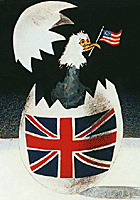 This week as I've kept abreast of the Churchill affair, continued my explorations of the politically-charged blogosphere, and viewed some of the cable news talk shows, I have also watched, repeatedly and as a form of therapy, the amiable musical 1776. I remember buying a paperback copy of the screenplay when I was 13. I loved it. Two years later I worked stage crew on a community theater production of 1776. I loved it all over again.
It's just fun. How many times do you get to see the Founding Fathers sing, dance, and crack jokes?
But it's also nostalgic, a reminder to me of what I once thought political life was like: informed, engaged, civil, and serious-minded in a way I rarely see these days. Or come to think of it, ever.
Informed? Most political conversation consists of sound bites and talking points--even in real life when time is not at a premium.
Engaged? People mostly talk and listen to those with whom they already agree.
Civil? When we do talk across party and ideological lines we think it's okay, even laudable, to have a discourse consisting largely of name-calling , slanders, half-truths, double standards, and mutual censorship (shut up! no, you shut up!).
Serious-minded? How many people who whoop it up about politics actually know anything about it? Useful political dialogue isn't just about opinions. There has to be a modicum of factual basis for discussions about policy, a reservoir of factual data on which people can agree. But we seem uninterested in finding a common data set from which an informed exchange of views can proceed.
It would be nice, of course, to believe this is something new and awful in American political life, that we can and should go back to "the good old days."
But let's face it, the old days never existed. I'm a Civil War historian, which means I am a chronicler of the greatest disaster this country's political culture ever produced. And even if I were a historian of some other place and period, things would not be that much better. Even the Founders existed in world characterized less by wigs and perfumed words than by the odor of burning homes and spent gunpowder.
Still, it is permissible to hope for better. It is permissible to insist on civil exchange and to cry foul when people resort to the usual crass tricks of politics as usual. I had to make up my mind about this recently when a former colleague decided to lob a few email grenades at a campus effort to remember the internment of Japanese Americans during World War II.
Continue to next page
Thursday, February 10, 2005
What the Heck?: A Quick Primer
One of the things about keeping the blog these days is that I don't have time to cover the issues that need covering and at the same time explain to readers the reasoning that underpins my selection and weighting of issues.
Some may wonder, for example, why a blog that has spent so much time engaging with the ideas of Tom Barnett in The Pentagon's New Map has of late spent so much time engaging with the ideas of Ward Churchill in On the Justice of Roosting Chickens.
The answer is, of course, obvious.
Some may wonder, for example, why a blog that has spent so much time engaging with the ideas of Tom Barnett in The Pentagon's New Map has of late spent so much time engaging with the ideas of Ward Churchill in On the Justice of Roosting Chickens.
The answer is, of course, obvious.
Russell Means on 9/11
To Whom It May Concern:
On Tuesday, September 11, 2001, I sat transfixed before the television watching the horror of the world trade center with many emotions running through my heart. On that day I said many prayers for the victims, families and the rescuers.
Since that painful day, I have read countless articles and editorials depicting the terror in newspapers from New York City, Los Angeles, Albuquerque and Santa Fe, NM. I have a feeling of sadness at the war mongering that has become the norm for patriarchal societies throughout history, up to and including today.
The remainder of that intolerable week, I tried to get through to New York City and the immediate area to find out how my friends and relatives were. Finally, on Friday and Saturday, I began getting messages through to my friends. On Sunday, September 16, my friend Rainer Greeven, Esq. called to assure me that he, his family and immediate friends were safe. However, within his own circle of friends and business associates he had been deeply affected. In fact, he told me he didn't know anyone in NYC that wasn't affected by tragedy. During the course of our conversation, he asked me what I thought our response, as a nation should be.
Full article
On Tuesday, September 11, 2001, I sat transfixed before the television watching the horror of the world trade center with many emotions running through my heart. On that day I said many prayers for the victims, families and the rescuers.
Since that painful day, I have read countless articles and editorials depicting the terror in newspapers from New York City, Los Angeles, Albuquerque and Santa Fe, NM. I have a feeling of sadness at the war mongering that has become the norm for patriarchal societies throughout history, up to and including today.
The remainder of that intolerable week, I tried to get through to New York City and the immediate area to find out how my friends and relatives were. Finally, on Friday and Saturday, I began getting messages through to my friends. On Sunday, September 16, my friend Rainer Greeven, Esq. called to assure me that he, his family and immediate friends were safe. However, within his own circle of friends and business associates he had been deeply affected. In fact, he told me he didn't know anyone in NYC that wasn't affected by tragedy. During the course of our conversation, he asked me what I thought our response, as a nation should be.
Full article
Russell Means on the Churchill Affair
I've now heard Denver talk show radio host Peter Boyles's interview with Russell Means, who might be called the dean of American Indian activists. Boyles does a much less effective job than with his Churchill interview. He is by turns patronizing, querulous, and borderline insulting.
In answer to a question asking his opinion the Churchill affair, Means responds that it's the tip of the iceberg" of a larger assault upon academe and the intelligentsia by an emerging "totalitarian" wave.
On Churchill's status as an Indian: Means is completely impatient with allegations that Churchill is not an Indian. "If he's a fake, I'm a fake."
Boyles won't let it go--snorts, guffaws, browbeats, baits Means, laughs when Means gets ticked off. Boyles reels off a list of individuals--about four--who impeach Churchill's status as an Indian. Means doesn't find them credible. From an interview standpoint, Boyles has asked the question. He's not satisfied with Means's answer, so he just keeps going. "So-and-so, is so-and-so a liar?"
The amazing thing is that apparently Boyles had a good relationship with Means before this train wreck of an interview. I can't imagine that he got anything from the interview worth the human capital expended. What a disappointment.
In answer to a question asking his opinion the Churchill affair, Means responds that it's the tip of the iceberg" of a larger assault upon academe and the intelligentsia by an emerging "totalitarian" wave.
On Churchill's status as an Indian: Means is completely impatient with allegations that Churchill is not an Indian. "If he's a fake, I'm a fake."
Boyles won't let it go--snorts, guffaws, browbeats, baits Means, laughs when Means gets ticked off. Boyles reels off a list of individuals--about four--who impeach Churchill's status as an Indian. Means doesn't find them credible. From an interview standpoint, Boyles has asked the question. He's not satisfied with Means's answer, so he just keeps going. "So-and-so, is so-and-so a liar?"
The amazing thing is that apparently Boyles had a good relationship with Means before this train wreck of an interview. I can't imagine that he got anything from the interview worth the human capital expended. What a disappointment.
Wednesday, February 09, 2005
Not on the "Taxpayers Dime"
Critics of Ward Churchill continue to blat that he espouses his opinions on "the taxpayers' dime," implying that as long as Churchill draws a professor's salary his First Amendment rights are somehow not as good as those of other people. Churchill blasted this kind of thinking in a speech last evening to a packed house at the University of Colorado.
'I do not work for taxpayers,' prof says
'I do not work for taxpayers,' prof says
Churchill throws down gauntlet at speech in Boulder
By Charlie Brennan, Rocky Mountain News
February 9, 2005
Most of the crowd that packed CU's Glenn Miller Ballroom for Churchill's speech appeared to be pulling for him in the fight of his professional life. It was his first public talk since becoming embroiled in controversy for his 3-year-old essay on the Sept. 11 attacks.
(E) "Little Eichmanns" - Part V

"The dump" in the hills above La Ceiba, Honduras, July 2002.

Since my last installment I've had a chance to read most of the commentary that L'Affaire Churchill has generated. I've also had a chance to take my first real look at what passes for discourse among the extreme Right. The comparison is illuminating. Although the Right is crying foul at the offensiveness of Churchill's essay, Churchill's "I offend, therefore I am" effort seems tentative and bush league compared with the likes of, say Michael Savage. Now there's a guy who knows how to be offensive!
Of course, Savage is not a member of my profession. Churchill is. I'm in no danger of getting tarred by anything Savage says, whereas some on the Right seem all too eager to make Churchill seem a representative figure within the humanities. So principle and self-interest oblige me to defend Churchill on free speech grounds. Even so, it would be nice to defend something that actually made a contribution to scholarly dialogue.
Well, if Churchill can't sustain the "little Eichmanns" metaphor, maybe I can.
Not, to be sure, in the way Churchill attempts it. Even if on September 12, 2001 (the day Churchill first published the essay), one could imagine that the "technocrats" in the World Trade Center were narrow, self-absorbed, hubristic, venal people, by 2004 (the year the essay appeared in book form) we had plenty of evidence to show otherwise. I have in front of me a copy of Portraits: 9/11/01: The Collected 'Portraits of Grief' from the New York Times (Henry Holt, 2002). To this could be added a number of online tributes and books such as On Top of the World: Cantor Fitzgerald, Howard Lutnik, & 9/11 (HarperCollins, 2003). Recent days have seen the publication of 102 Minutes: The Untold Story of the Fight to Survive Inside the Twin Towers (Henry Holt, 2005).
Still, the operative dynamic within the "Eichmann analogy" is not volitional evil, as Churchill's critics assume. It is the compartmentalization and bureaucratization that characterizes modern life. It is the way we have learned to do the job in front of us without asking, "What is the relationship of this task to the whole of life?" We take on faith the idea that if we do our jobs, the world benefits. But it is not unreasonable to suppose that our jobs influence the world in ways that are subtle, sometimes contradictory, and arguably harmful or even lethal in their ultimate results. We're not to the "little Eichmann" threshold yet--there's a lot one has to consider in order to build an analytical bridge that far--but the central dynamic of bureaucratization is too obvious to miss.
I will give one brief example. The other evening I took a digital camera to my local grocery store. I wanted to take a photo contrasting the abundance here domestically--at least here in subburbia--with the abject poverty of "the dump," shown above. I was composing my first shot when a manager came up to me, plainly agitated. It transpired that the grocery store had a policy against anyone taking photographs without permission from corporate public relations.
The manager was agitated because he feared a confrontation. After all, what could I possibly be doing with a digital camera in the store? Maybe--probably--I was a prospective litigator and therefore a threat. I just shrugged and said I didn't mind not taking the photo, but could I have the phone number of corporate PR? And what purpose was being served by the policy? The manager unbent, but only a little, and stayed in bureaucratic mode.
You might say, there's nothing exceptional about this. You'd be right. We're used to this way of organizing life. But think for a moment about how different the exchange would have been if the manager and I had been organically part of the same community. I could have told him my reasons for wanting the photo; he would have listened and would surely have had the authority, in an older store, to let me take a photo. We would, in short, have had a human exchange in which each of us would have learned more about the other. As it turned out, we had a bureaucratic exchange. The manager did not make the policy. He did not seem to understand why it was made or what purpose it served. He did not ask--did not have authority to ask--whether my project represented a threat or opportunity to the company he worked for. All he knew was that a policy existed and he was obliged to enforce it.
Just so: In the suites of the Twin Towers, there were deals to be made--deals composed of hundreds of component deals--and perched before the CRT screens lay rank upon rank of employees--"technocrats," in Churchill's phrase, whose job it was to look at their chunk of the deal, address a few equations, and move the deal along. Indispensable to the process, they nevertheless labored without knowing, without being encouraged to know or even having the information to know, whether the ultimate result of a given deal would improve the world or harm it.
Continue to next page
WarHistorian.org
War Historian will shortly be moving to its permanent digs under its own domain name, warhistorian.org. The Blogger site will continue to operate for a time as an archive and to direct traffic to the new site.
In coming months I would like to see War Historian become a group or organizational blog aimed at bringing together scholars of all fields who are interested in issues of war and collective violence, broadly conceived. For more as to purpose, see this entry.
I've also created a second domain, MarkGrimsley.com, to handle personal projects, though the two sites will be closely linked.
In coming months I would like to see War Historian become a group or organizational blog aimed at bringing together scholars of all fields who are interested in issues of war and collective violence, broadly conceived. For more as to purpose, see this entry.
I've also created a second domain, MarkGrimsley.com, to handle personal projects, though the two sites will be closely linked.
David Horowitz: Retain Churchill, Build Real Diversity
I'm not a big David Horowitz fan, but this piece makes a fair degree of sense--except the part about firing Churchill if he turns out not to be an American Indian. Definitions of who is and who isn't an Indian are too loose for that.
By David Horowitz
February 8, 2005
It will probably come as a surprise to many people, both friend and foe alike, that I am opposed to any attempt to fire Ward Churchill for the essay (now part of a book) that has become notorious in which he denounces his own country as a genocidal empire, supports America's terrorist enemies, and says that 9/11 was a case of the "chickens coming home to roost."
Colorado Talk Radio and Ward Churchill
You can listen to Denver radio talk show host Peter Boyles's interview with Ward Churchill here. Also a second interview with Indian activist Russell Means. And two Ward Churchill parody songs. The first is less than successful; the second (to the tune of Paul Revere and Raiders' "Indian Reservation) is not bad. Interestingly, both parodies focus less on Churchill's "little Eichmann" remarks than on recent questions concerning his claims to Native American heritage.
Update, 4:25 a.m.: I've heard the entire Churchill interview.
Peter Boyles deserves respect for handling a volatile subject with more grace and professionalism--by far--than any radio or television talk show host I have yet heard.
Boyles's principal guest, besides Churchill, is Peter Gadiel, whose son James Gadiel worked as an assistant trader for Cantor Fitzgerald. (For Cantor Fitzgerald's story of how it coped with 9/11, check here.) A 2000 graduate of Washington and Lee University, James was 23 years old when he died. Peter Gadiel is a director of 9/11 Families for a Secure America, an organization that emphasizes the need to maintain strict controls on traffic across U.S. borders. Gadiel, incidentally, condemns any and all death threats received by Churchill.
Churchill, to my ears, has a difficult time explaining himself in this and in other interviews. This is a bit odd considering that he is a very plain-spoken individual who on most subjects is not hard to follow. But he really can't get the "Eichmann analogy" to pop, and I rather have a suspicion the failure is purposeful. If you're an academic already familiar with his work, you can fill in the gaps and silences he leaves, but he misses repeated opportunities to explain the analogy. After a while it's hard to avoid the impression that he has a nicely-developed technique for provoking people unfamiliar with his work while sounding patient and reasonable to those knowledgeable about it.
Toward the end of the interview, Colorado state senator Tom Wiens calls in with a few background queries about Churchill. He says he was going to plut a staffer to work researching the questions, but thought he would take advantage of the interview to ask Churchill directly. His questions concerned Churchill's credentials, teaching load, and salary. Churchill gave him candid answers to each. Wiens went on to say that he had skimmed the online version of the controversial essay and averred that his main concern was its seemingly poor scholarship. Churchill asked what were Wiens's qualifications to evaluate the essay. Wiens replied, in essence, that he had received a good education and could make intelligent evaluations about thesis, argument, use of evidence, and adequacy of citation. (He assuredly sounded as if he could. Indeed, all in all, Wiens came across as the sort of intelligent, serious, sober-minded legislator I'd like to have representing me.)
All in all, the Peter Boyles interview, though a bumpy ride, makes Scarborough Country look like the pathetically incompetent pseudojournalism it is.
Update, 4:25 a.m.: I've heard the entire Churchill interview.
Peter Boyles deserves respect for handling a volatile subject with more grace and professionalism--by far--than any radio or television talk show host I have yet heard.
Boyles's principal guest, besides Churchill, is Peter Gadiel, whose son James Gadiel worked as an assistant trader for Cantor Fitzgerald. (For Cantor Fitzgerald's story of how it coped with 9/11, check here.) A 2000 graduate of Washington and Lee University, James was 23 years old when he died. Peter Gadiel is a director of 9/11 Families for a Secure America, an organization that emphasizes the need to maintain strict controls on traffic across U.S. borders. Gadiel, incidentally, condemns any and all death threats received by Churchill.
Churchill, to my ears, has a difficult time explaining himself in this and in other interviews. This is a bit odd considering that he is a very plain-spoken individual who on most subjects is not hard to follow. But he really can't get the "Eichmann analogy" to pop, and I rather have a suspicion the failure is purposeful. If you're an academic already familiar with his work, you can fill in the gaps and silences he leaves, but he misses repeated opportunities to explain the analogy. After a while it's hard to avoid the impression that he has a nicely-developed technique for provoking people unfamiliar with his work while sounding patient and reasonable to those knowledgeable about it.
Toward the end of the interview, Colorado state senator Tom Wiens calls in with a few background queries about Churchill. He says he was going to plut a staffer to work researching the questions, but thought he would take advantage of the interview to ask Churchill directly. His questions concerned Churchill's credentials, teaching load, and salary. Churchill gave him candid answers to each. Wiens went on to say that he had skimmed the online version of the controversial essay and averred that his main concern was its seemingly poor scholarship. Churchill asked what were Wiens's qualifications to evaluate the essay. Wiens replied, in essence, that he had received a good education and could make intelligent evaluations about thesis, argument, use of evidence, and adequacy of citation. (He assuredly sounded as if he could. Indeed, all in all, Wiens came across as the sort of intelligent, serious, sober-minded legislator I'd like to have representing me.)
All in all, the Peter Boyles interview, though a bumpy ride, makes Scarborough Country look like the pathetically incompetent pseudojournalism it is.
Ann Coulter on Radical Chic
On Scarborough Country, the inimitable Ann Coulter actually has a perceptive point about academics with tenure who act as if, by speaking their minds, they're doing something courageous. That's a cheap and easy game if you're shielded from consequences, she notes. Then, perhaps disquieted by the fact that she's actually making sense, she puts her rhetorical Mack truck in gear and drives it straight off a cliff:
"These guys want to go around acting like big radicals, getting laid by coeds with hairy armpits, who probably don‘t like men, by going to conferences and saying, oh, yes, I‘m the one who said that."
"These guys want to go around acting like big radicals, getting laid by coeds with hairy armpits, who probably don‘t like men, by going to conferences and saying, oh, yes, I‘m the one who said that."
Scarborough Country Transcript
Joe Scarborough (Scarborough Country, MSNBC), apparently thinks the Churchill imbroglio is his ticket to a loftier place in the crowded punditocracy firmament. He certainly deserves it--he's certainly as good as anyone else at making a cruel mockery of constructive political discourse. (For a model of constructive conservative engagement, check out Charles Colson's Breakpoint commentaries.)
Scarborough's Feb. 7 deals in part with the Churchill matter. That part of the exchange begins about halfway down, starting here:
UPDATE: For a report on this interview and a link to an audio recording of the interview, see Colorado Talk Radio and Ward Churchill.
(The full Scarborough Country transcript is here.)
Anyway, it's another depressing demonstration that right-wing pundits pretend to loathe the Churchills of the world but in fact depend on them. Without such people, the Scarboroughs of the world might actually have to resort to thoughtful engagement. Again, check out Charles Colson if you want to see what meaningful political discussion looks like. You sure won't get it from Scarborough.
Scarborough's Feb. 7 deals in part with the Churchill matter. That part of the exchange begins about halfway down, starting here:
Coming up next, Ward Churchill‘s latest outrageous statement. You are not going to believe it.
That‘s when SCARBOROUGH COUNTRY returns.
(COMMERCIAL BREAK)
SCARBOROUGH: More shocking comments from Colorado Professor Ward Churchill, who attacks America and says—what does he say on the taxpayers‘ dime? That we need more 9/11s.
That story next.
(COMMERCIAL BREAK)
(NEWS BREAK)
SCARBOROUGH: Now, as we told you last week, University of Colorado Professor Ward Churchill faces possible firing for comparing 9/11 victims to Nazis and for praising al Qaeda terrorists who killed 3,000 Americans. He called them heroes. The university has 30 days to read everything that Churchill has written. And they may want to read this interview from 2004.
He said—quote—“One of the things I suggested is that it may be that more 9/11s are necessary. This seems like such a no-brainer that I hate to frame it in terms of actual transformation of consciousness.”
Now, Denver radio talk show host Peter Boyles spoke to Churchill and the father of a 9/11 victim last week. Let‘s listen to that exchange.
(BEGIN AUDIO CLIP)
FATHER OF 9/11 VICTIM: My son was an assistant trader at Cantor Fitzgerald. He was 23, his first job out of college.
(CROSSTALK)
WARD CHURCHILL, PROFESSOR, UNIVERSITY OF COLORADO: Well, I would like to do something here. I would like to engage you.
PETER BOYLES, RADIO TALK SHOW HOST: Let me ask him, if I could, before it gets away, Ward, would his son have qualified as one of the little Eichmanns?
CHURCHILL: Yes, he would have.
(END AUDIO CLIP)
Yeah, don't give Churchill a chance to contextualize his remark. I'm not sure Churchill could dig himself out, but why take a chance that the TV audience might hear him try and think he managed to do it? Why not lead them around by the nose instead?UPDATE: For a report on this interview and a link to an audio recording of the interview, see Colorado Talk Radio and Ward Churchill.
(The full Scarborough Country transcript is here.)
Anyway, it's another depressing demonstration that right-wing pundits pretend to loathe the Churchills of the world but in fact depend on them. Without such people, the Scarboroughs of the world might actually have to resort to thoughtful engagement. Again, check out Charles Colson if you want to see what meaningful political discussion looks like. You sure won't get it from Scarborough.
Statements by Ward Churchill and the AAUP
A statement from Churchill dated January 31 concerning "recent inaccurate accusations," and an undated statement from the American Association of University Professors (AAUP). Both are currently posted on Speak Out!, a speaker's bureau representing Churchill and 200 other speakers and artists for campus and university events.
Tuesday, February 08, 2005
(F) Indian Country Today Weighs in on Churchill
From the Feb. 3 issue:
Churchill's identity revealed in wake of Nazi comment
A public speaking engagement at an Eastern college has turned hotly controversial for Ward Churchill, a professor and until last week the chairman of Ethnic Studies Department at the University of Colorado at Boulder.
Churchill, a self-professed American Indian, is a prolific and highly polemical writer on Indian issues. Shortly after the murderous attacks of Sept. 11, 2001 in New York, Washington, D.C. and over Pennsylvania, Professor Churchill widely circulated an article in which he compared the victims of those attacks to Nazi functionary Adolf Eichmann, and to all appearances called their horrific deaths a ''befitting ... penalty'' for the ''little Eichmanns' ... participation.''
This week the Boulder professor's public representation of the 9/11 victims became the focal point of a serious broadside. . . . . The focus of calls now is for Churchill to resign or be fired from his tenured position.
The case of a professor or any other American exercising the right of free speech is always important to us. We support that fundamental right more than any other and believe that even the extreme views of others (which sometimes become mainstream) must be defended against any force that would silence our First Amendment rights as citizens and as free human beings.
The nature of Churchill's decidedly offensive remarks, however, forces us to critique in general the injurious approach to scholarship and basic human decency.
Full editorial here
Churchill's identity revealed in wake of Nazi comment
A public speaking engagement at an Eastern college has turned hotly controversial for Ward Churchill, a professor and until last week the chairman of Ethnic Studies Department at the University of Colorado at Boulder.
Churchill, a self-professed American Indian, is a prolific and highly polemical writer on Indian issues. Shortly after the murderous attacks of Sept. 11, 2001 in New York, Washington, D.C. and over Pennsylvania, Professor Churchill widely circulated an article in which he compared the victims of those attacks to Nazi functionary Adolf Eichmann, and to all appearances called their horrific deaths a ''befitting ... penalty'' for the ''little Eichmanns' ... participation.''
This week the Boulder professor's public representation of the 9/11 victims became the focal point of a serious broadside. . . . . The focus of calls now is for Churchill to resign or be fired from his tenured position.
The case of a professor or any other American exercising the right of free speech is always important to us. We support that fundamental right more than any other and believe that even the extreme views of others (which sometimes become mainstream) must be defended against any force that would silence our First Amendment rights as citizens and as free human beings.
The nature of Churchill's decidedly offensive remarks, however, forces us to critique in general the injurious approach to scholarship and basic human decency.
Full editorial here
Monday, February 07, 2005
(D) Return to Ground Zero
I'm still working on the "Little Eichmanns" essay.
It began as a short essay. I didn't know how long it would be when I started it. I think I expected it to run maybe a thousand words. It's well past that now. And it's beginning to pull me in. I mean, really pull me in.
I think in part that's because Churchill did such a sloppy job with the material. It makes me embarrassed for the profession. I feel like it's not enough to "mutter about free speech," as Joe Scarborough puts it. I've got to show that this material can be handled better. That it's possible to use a phrase like "little Eichmanns" and have it mean something. Or failing that, to figure out for myself, independently, just how bad an analogy that is.
So the books start to pile up the way the books do when you're chasing down the past. I'm primarily a 19th century historian, so when I use evidence it's mostly books, articles, and old newspapers, letters, and diaries. But because this past is so recent, I find myself working with sources I have never used before. For instance, this afternoon I spent a couple of hours watching 9/11, a documentary made by two brothers--Jules and Gedeon Noudet--who by happenstance were within a few blocks of the World Trade Center on September 11.
Until the first plane struck the WTC (the film is one of the few sources to show the initial strike, the Noudet brothers were working on a documentary about a rookie New York firefighter. They quickly became swept up in the NYC firemen's effort to control the fire at first the North Tower and then, within a quarter-hour, the South Tower as well. The firefighters, not the "technocrats"--the "little Eichmanns"--are the focus of the film. But at intervals the scenes shot within the lobby of the North Tower are punctuated by massive whacks, as if huge boulders were crashing nearby. These were in fact the sound of bodies striking the ground outside.
Reviews of 9/11 (I tried to pick non-obvious reviews)
Spirituality and Health.com
Reno, NV, Gazette-Journal
BBC News 1-Year Retrospective on 9/11. Has a 25-minute interview with the Naudet brothers.
It began as a short essay. I didn't know how long it would be when I started it. I think I expected it to run maybe a thousand words. It's well past that now. And it's beginning to pull me in. I mean, really pull me in.
I think in part that's because Churchill did such a sloppy job with the material. It makes me embarrassed for the profession. I feel like it's not enough to "mutter about free speech," as Joe Scarborough puts it. I've got to show that this material can be handled better. That it's possible to use a phrase like "little Eichmanns" and have it mean something. Or failing that, to figure out for myself, independently, just how bad an analogy that is.
So the books start to pile up the way the books do when you're chasing down the past. I'm primarily a 19th century historian, so when I use evidence it's mostly books, articles, and old newspapers, letters, and diaries. But because this past is so recent, I find myself working with sources I have never used before. For instance, this afternoon I spent a couple of hours watching 9/11, a documentary made by two brothers--Jules and Gedeon Noudet--who by happenstance were within a few blocks of the World Trade Center on September 11.
Until the first plane struck the WTC (the film is one of the few sources to show the initial strike, the Noudet brothers were working on a documentary about a rookie New York firefighter. They quickly became swept up in the NYC firemen's effort to control the fire at first the North Tower and then, within a quarter-hour, the South Tower as well. The firefighters, not the "technocrats"--the "little Eichmanns"--are the focus of the film. But at intervals the scenes shot within the lobby of the North Tower are punctuated by massive whacks, as if huge boulders were crashing nearby. These were in fact the sound of bodies striking the ground outside.
Reviews of 9/11 (I tried to pick non-obvious reviews)
Spirituality and Health.com
Reno, NV, Gazette-Journal
BBC News 1-Year Retrospective on 9/11. Has a 25-minute interview with the Naudet brothers.
(F) DVDs re the War on Terrorism
9/11 (2002)
In Memoriam: New York City, 9/11/01 (2002)
Operation Enduring Freedom (2002)
Twin Towers (2004)
7 Days in September (2004)
Control Room (2004)
Fahrenheit 9/11 (2004)
Fahrenhype 9/11 (2004)
Uncovered: The Whole Truth About the Iraq War (2004)
In Memoriam: New York City, 9/11/01 (2002)
Operation Enduring Freedom (2002)
Twin Towers (2004)
7 Days in September (2004)
Control Room (2004)
Fahrenheit 9/11 (2004)
Fahrenhype 9/11 (2004)
Uncovered: The Whole Truth About the Iraq War (2004)
(F) Press Action Defends Churchill
One of the few entities willing to defend Churchill these days is PressAction.com, which has run a number of articles on the "little Eichmanns" imbroglio. Here are permalinks to some of these; there are others I haven't included, but if you can find these you can locate the others.:
Ward Churchill Under Attack (Feb. 1)
The Distortions of Acumen: Liberals Trash Ward Churchill (Feb. 5)
Churchill, Eichmann, and Those 9/11 Technocrats (Feb. 5)
Growing Chorus: Prosecute Ward Churchill for Treason (Feb. 6)
Ward Churchill Under Attack (Feb. 1)
The Distortions of Acumen: Liberals Trash Ward Churchill (Feb. 5)
Churchill, Eichmann, and Those 9/11 Technocrats (Feb. 5)
Growing Chorus: Prosecute Ward Churchill for Treason (Feb. 6)
The War Dogs Ride - Part IIn

Picking up a few last must-haves. All in all, I bought enough books to very nearly fill a five-shelf wall unit.



The War Dogs Ride - Part IIj

The Village Book shop, the midwest's largest dealer in overstock and remaindered books. I've been haunting the place since I was sixteen.
The War Dogs Ride - Part IIi

Gypsy in the back seat--hey, if you're taking my picture, who's driving the car?


The War Dogs Ride - Part IIg

Which is the higher allegiance: God or country? If our steeple is patriotic, we needn't choose!
The War Dogs Ride - Part IIf

I approach, mesmerized by the thought of what lies inside. Books. Must have more.
The War Dogs Ride - Part IIe
Third stop: Barnes and Noble near campus. Jethro: "Don't spend too much!"
The War Dogs Ride - Part IId

Second stop: the Mershon Center. Grabbing some books from my office. Mostly stuff dealing with atrocity, moral judgment in war, and globalization: the sort of materials needed to continue the "Little Eichmanns" essay.
The War Dogs Ride - Part IIc
Looking over my stack of books, the cashier has a question. Why, if the conservatives control all three branches of government, do they seem so angry? Not all of them are, but you wouldn't know that to read Bill O'Reilly, Michael Savage, Ann Coulter, et al.
The War Dogs Ride - Part IIb

First stop: Half Price Books near campus. This place tends to have the best selection of academically-oriented books for cheap. Note: I myself have yet to get remaindered; all my stuff is still in print and carried in inventory. Of course, that means I've yet to make the big kill that would result in a press run large enough to wind up yielding remainders.
(D) The War Dogs Ride - Part IIa

Gypsy before the ride: C'mon Mark G., Exercise at least some restraint.
Sunday, February 06, 2005
(D) The War Dogs Ride! - Part I
 Got a good night's sleep Friday, and on Saturday hit several book stores, giving my credit card a workout and stocking up on three interelated categories of books: works dealing with globalization, works reflective of the current state of domestic political discourse, and works on the War on Terrorism. Accompanying me were my two doughty war dogs: Jethro (shown), and Gypsy (who is reclusive about photos, as she believes they steal her spirit).
When I get time I'll create at least an author/title bibliography, because all told I must have bought fifty books and I can't keep them all straight in my head. But for now I will only say that among the books purchased were a number by pundits on both the Right and Left, mostly the Right. For example:
Ann Coulter, Treason: Liberal Treachery from the Cold War to the War on Terrorism (2003).
Ann Coulter, How to Talk to a Liberal (If You Must): The World According to Ann Coulter (2004).
(Thank goodness for the remainder table, which is where most of this, ah, genre lands within a few months of publication.)
Sean Hannity, Let Freedom Ring: Winning the War of Liberty Over Liberalism (2002).
Sean Hannity, Deliver Us From Evil: Defeating Terrorism, Despotism, and Liberalism (2004).
(Note to self: what's with the tight-lipped smile these people all display on their book covers? Why not a broad, friendly, we - control - all - three - branches - of - government grin?)
I'd be curious to know if CRO (see "Little Churchills") would permit me to dissent from the conservative line in class if it knew I had made an effort to read conservative opinion--and indeed, I read not only this fun but superficial stuff but also more serious paleo-con and neo-con opinion: William Kristol is a particular favorite of mine. My guess is that CRO would regard merely reading conservative opinion as just a particularly insidious form of political correctness. You have to agree with it whole-heartedly or you're still PC.
Whence the impetus for this book-buying binge? Well, to begin with, I'm a book junkie, so the see - the - pretty - book - I - must - have - it reflex is well-established in me. Second, the blogosphere is so awash in political opinion you can't help but get sucked in. Third, some of this stuff--not the Coulters and the Hannitys but the more serious neo-con opinion--is stuff I'll need for a new book project, or more precisely, the lastest proposed vehicle for the old book project.
Finally, while hitherto I may not have been interested in the Coulters, Hannitys, and Joe Scarboroughs of the world, plainly they are interested in me. Apparently they have trouble distinguishing me from academics of like Ward Churchill. I can't imagine why--aren't the differences obvious?

More to come.
(F) Little Churchills
Nice turnabout on "little Eichmanns" by Malcolm A. Kline of CampusReportOnline.net, Accuracy in Academia's "online news service in which we document and publicize political bias in education. Our articles focus on three issues: the exploitation of the classroom or university resources to indoctrinate students; discrimination against students, faculty or administrators based on political or academic beliefs; and campus violations of free speech." Here's the article re professors who supposedly have made statements equivalent to Churchill's. Apparently if you suggest that others besides Americans suffer pain and anguish when their loved ones die, that's equivalent to the "little Eichmanns" remark.
Oh, and "accuracy in academia" involves remembering the "sensibilities" of those who pay the taxes that support higher education. That might be politic, but a prerequisite for accurate?
Oh, and it would help me be more "accurate" in my opinions if I were to lobby university administrators to get ROTC onto more college campuses. (On both points, see the end of this article.)
Oh, and this is (needless to say) not a nonpartisan group dedicated to accuracy in academia on the part of all who have a voice, but rather a group organized to "battle political correctness and further the conservative movement."
Lastly--big surprise--nowhere on this site are there criteria by which one may distinguish legitimate non-conservative opinion from abuses of free speech. I'm guessing that's not an issue CRO cares to parse. Nor are there reports on professors who serve as models of vigorous but fair-minded exchange. Nor advice about how students can think critically for themselves. Nor-- ah jeez: let's face it, these guys want to indoctrinate students as badly as anyone on the Left, just in a different way.
But ya gotta love the "little Churchills" thing.
Oh, and "accuracy in academia" involves remembering the "sensibilities" of those who pay the taxes that support higher education. That might be politic, but a prerequisite for accurate?
Oh, and it would help me be more "accurate" in my opinions if I were to lobby university administrators to get ROTC onto more college campuses. (On both points, see the end of this article.)
Oh, and this is (needless to say) not a nonpartisan group dedicated to accuracy in academia on the part of all who have a voice, but rather a group organized to "battle political correctness and further the conservative movement."
Lastly--big surprise--nowhere on this site are there criteria by which one may distinguish legitimate non-conservative opinion from abuses of free speech. I'm guessing that's not an issue CRO cares to parse. Nor are there reports on professors who serve as models of vigorous but fair-minded exchange. Nor advice about how students can think critically for themselves. Nor-- ah jeez: let's face it, these guys want to indoctrinate students as badly as anyone on the Left, just in a different way.
But ya gotta love the "little Churchills" thing.
(D) A New Plan
I have never been a very systematic person. Get me interested in something and I don't figure out one book to read on the subject. I figure out thirty or fifty or ninety. And I don't read them in some predetermined order, but rather dip into them all at once. It isn't the most efficient use of time and effort. It's merely the use that suits me.
As with reading, so too with things analogous. Until it was noticed by a significant number of readers (or until those readers were noticed by it), War Historian had only one gait: the discursive or diary-type entry (D), though some of these were developed sufficiently to merit the name of informal essay (E). Safe to say, however, that I had never tried the sort of entry that is composed mainly of a link to a newsworthy item; i.e., a "filter" blog entry (F). That last type, however, has been the mainstay of War Historian since about Jan. 22. And useful such entries have been as a way of letting me post daily (at least) while having time to gain a better handle on the blogosphere. I've found a lot of stuff I never would have guessed was up here. Who would have thought, for instance, that online users would handicap sites like this one as if they were shares on the New York Stock Exchange?
You might call all this surfing the blogosphere the equivalent of a reconnaissance. Maybe even a reconnaisance in force. But it's time to recover the patrol to make its report, and time to regularize the blog once more.
People seem willing to let a blog be about anything, and yet they also appear to insist on certain conventions. For example, you have to post regularly, at more or less predictable intervals. You have to have a consistent style or voice. You have to have a focused "beat," or range of topics that come under discussion. Apparently it helps to be pithy. I've somewhere read that most readers prefer posts they can digest in a couple of minutes.
I can't be helpful on the last score, because I find the discursive entry more useful for my purposes. But I can certainly be better organized in other ways, and I'm ready to routinize the blog again. Basically here's the plan:
One diary- or discursive-type (D) entry per day;
one or more filter-type (F) entries per day;
one essay-type (E) entry per week, to appear on Fridays.
I'll try to incorporate as many links as I can, so that readers can move smoothly from one discursive entry to the next. But since I actually have a life and may not always have time to do this, starting with the February entries I am adding D, E, or F at the start of the title to each entry, so that readers will have an easier time navigating on their own.
Continue to next discursive entry.
As with reading, so too with things analogous. Until it was noticed by a significant number of readers (or until those readers were noticed by it), War Historian had only one gait: the discursive or diary-type entry (D), though some of these were developed sufficiently to merit the name of informal essay (E). Safe to say, however, that I had never tried the sort of entry that is composed mainly of a link to a newsworthy item; i.e., a "filter" blog entry (F). That last type, however, has been the mainstay of War Historian since about Jan. 22. And useful such entries have been as a way of letting me post daily (at least) while having time to gain a better handle on the blogosphere. I've found a lot of stuff I never would have guessed was up here. Who would have thought, for instance, that online users would handicap sites like this one as if they were shares on the New York Stock Exchange?
You might call all this surfing the blogosphere the equivalent of a reconnaissance. Maybe even a reconnaisance in force. But it's time to recover the patrol to make its report, and time to regularize the blog once more.
People seem willing to let a blog be about anything, and yet they also appear to insist on certain conventions. For example, you have to post regularly, at more or less predictable intervals. You have to have a consistent style or voice. You have to have a focused "beat," or range of topics that come under discussion. Apparently it helps to be pithy. I've somewhere read that most readers prefer posts they can digest in a couple of minutes.
I can't be helpful on the last score, because I find the discursive entry more useful for my purposes. But I can certainly be better organized in other ways, and I'm ready to routinize the blog again. Basically here's the plan:
One diary- or discursive-type (D) entry per day;
one or more filter-type (F) entries per day;
one essay-type (E) entry per week, to appear on Fridays.
I'll try to incorporate as many links as I can, so that readers can move smoothly from one discursive entry to the next. But since I actually have a life and may not always have time to do this, starting with the February entries I am adding D, E, or F at the start of the title to each entry, so that readers will have an easier time navigating on their own.
Continue to next discursive entry.
Saturday, February 05, 2005
(F) Joe Scarborough: Up Against the Wall, Ultraliberal Profs!
Time is up for radical professors like Ward Churchill (Joe Scarbough) [sic!!]
 |
(F) The Churchill Affair: Ramifications
Ralph Lukens at Cliopatria continues to update his links on L'Affaire Churchill. That's how I came to read this terrific entry in D.B. Light's blog, Light Seeking Light. As Light documents, the right is using Churchill's "little Eichmann" comment to go after those in academe more generally. This is important stuff. Assuming you think academe is important.
(F) Job Position in Military History
From Prof. Reina Pennington, Dept. of History, Norwich University
Hi all. Norwich is starting an online MA program in Military History (MMH), and we need a director to run it. We hope to do preliminary interviews at SMH. It's a short deadline, since we need someone who can be here by July if at all possible. (We will also be looking for course developers and online instructors.)
Norwich has several other very successful online master's programs. The MMH would join our MA in Diplomacy (political science-based) and a Center for the Study of War and Peace. The actual courses are just now being developed, so there is room for the new director to put a personal stamp on it.
Please pass along the announcement below.
*****************************************
Reina Pennington, PhD
Studies in War and Peace Program Coordinator
Department of History, Norwich University
158 Harmon Drive, Northfield VT 05663
(802) 485-2365 - Office
(802) 485-2252 - Fax
e-mail: rpenning@norwich.edu or rpennington@madriver.com
*****************************************
Position: Program Director
Institution: Norwich University
Location: Vermont
Application deadline: 3/15/2005
Employment Opportunity: Program Director, Master of Arts in Military History
Norwich University seeks an outstanding scholar/administrator to serve as director of its new online program offering a Master of Arts in Military History (MMH). We are looking for a director at the Associate or Full Professor level who is a recognized scholar in military history. The directorship is a 12-month position, and is a tenure-track slot with half-time teaching responsibilities in the Department of History. We are particularly interested in applicants with fields in 19th century American military history (to balance undergraduate teaching needs), but will consider all qualified candidates. The MMH program will be a broad-ranging program covering a variety of fields in military history.
Qualifications: PhD in history from an accredited institution. Demonstrated commitment to the field of military history evident in teaching, publication, research, and conference participation. Evidence of success in teaching and advising students. Experience in administration and on-line programs is a plus, but Norwich has a strong support structure and will train the right person. Collegial on-line writing style; after curriculum and instructor management, the Director's most important role is as a communicator with a constant presence. Ability to work congenially with staff, students, and colleagues.
Administrative responsibilities: Develop and maintain curriculum. Recruit, hire, orient, train, and manage qualified instructors. Organize academic events for the annual residency. Be a leader; creatively manage staff, students, and instructors.
Seehttp://www3.norwich.edu/grad/ for general program information. Contact Ellalou Zirblis if you would like detailed information on the MMH program and a complete administrative job description.
Start date: July 1, 2005.
The search committee will begin reviewing applications immediately. Norwich is sponsoring a reception to announce this new program at the Society for Military History annual conference in Charleston, SC (24-26 Feb 2005) and will conduct initial interviews at that conference. Applications will be accepted until March 15th. The position will remain open until filled.
Please send a letter of application referring specifically to this search, a CV, one sample of published scholarship, and the names and addresses of three to five references who may be contacted by the search committee. Additional application materials may be requested at a later date. Application materials should be sent to:
Military History Program Director Search
Human Resources
Norwich University
158 Harmon Drive
Northfield, Vermont 05663
Norwich University is an Equal Opportunity employer; women and minorities are encouraged to apply.
Norwich offers a comprehensive benefit package that includes medical, dental, group life and long term disability insurance, flexible spending accounts for health and dependent care, a retirement annuity plan, and tuition scholarships for eligible employees and their family members.
Hi all. Norwich is starting an online MA program in Military History (MMH), and we need a director to run it. We hope to do preliminary interviews at SMH. It's a short deadline, since we need someone who can be here by July if at all possible. (We will also be looking for course developers and online instructors.)
Norwich has several other very successful online master's programs. The MMH would join our MA in Diplomacy (political science-based) and a Center for the Study of War and Peace. The actual courses are just now being developed, so there is room for the new director to put a personal stamp on it.
Please pass along the announcement below.
*****************************************
Reina Pennington, PhD
Studies in War and Peace Program Coordinator
Department of History, Norwich University
158 Harmon Drive, Northfield VT 05663
(802) 485-2365 - Office
(802) 485-2252 - Fax
e-mail: rpenning@norwich.edu or rpennington@madriver.com
*****************************************
Position: Program Director
Institution: Norwich University
Location: Vermont
Application deadline: 3/15/2005
Employment Opportunity: Program Director, Master of Arts in Military History
Norwich University seeks an outstanding scholar/administrator to serve as director of its new online program offering a Master of Arts in Military History (MMH). We are looking for a director at the Associate or Full Professor level who is a recognized scholar in military history. The directorship is a 12-month position, and is a tenure-track slot with half-time teaching responsibilities in the Department of History. We are particularly interested in applicants with fields in 19th century American military history (to balance undergraduate teaching needs), but will consider all qualified candidates. The MMH program will be a broad-ranging program covering a variety of fields in military history.
Qualifications: PhD in history from an accredited institution. Demonstrated commitment to the field of military history evident in teaching, publication, research, and conference participation. Evidence of success in teaching and advising students. Experience in administration and on-line programs is a plus, but Norwich has a strong support structure and will train the right person. Collegial on-line writing style; after curriculum and instructor management, the Director's most important role is as a communicator with a constant presence. Ability to work congenially with staff, students, and colleagues.
Administrative responsibilities: Develop and maintain curriculum. Recruit, hire, orient, train, and manage qualified instructors. Organize academic events for the annual residency. Be a leader; creatively manage staff, students, and instructors.
See
Start date: July 1, 2005.
The search committee will begin reviewing applications immediately. Norwich is sponsoring a reception to announce this new program at the Society for Military History annual conference in Charleston, SC (24-26 Feb 2005) and will conduct initial interviews at that conference. Applications will be accepted until March 15th. The position will remain open until filled.
Please send a letter of application referring specifically to this search, a CV, one sample of published scholarship, and the names and addresses of three to five references who may be contacted by the search committee. Additional application materials may be requested at a later date. Application materials should be sent to:
Military History Program Director Search
Human Resources
Norwich University
158 Harmon Drive
Northfield, Vermont 05663
Norwich University is an Equal Opportunity employer; women and minorities are encouraged to apply.
Norwich offers a comprehensive benefit package that includes medical, dental, group life and long term disability insurance, flexible spending accounts for health and dependent care, a retirement annuity plan, and tuition scholarships for eligible employees and their family members.
(F) PoMo English Title Generator
A new way to "interrogate the project of military history" . . .
Let's revisit, say,
Russell F. Weigley, The American Way of War
Here are 5 means by which you might destabilize, decenter, deconstruct, or otherwise devalue that book:
1.
Identity and Community in The American Way of War: Russell F. Weigley Defamiliarizing Materialist Mythos
2.
Russell F. Weigley Alienating Representation: The American Way of War and the (Author)ity of Breath
3.
Russell F. Weigley, The American Way of War, and The Invader: Visioning Savage Darkness
4.
Encoding, Challenging, Transforming: Darkness in Russell F. Weigley and the Theoretical Politics of Seduction in The American Way of War
5.
Pathologizing the Objectified Tyranny in Russell F. Weigley: The American Way of War and Fragmentation
Let's revisit, say,
Russell F. Weigley, The American Way of War
Here are 5 means by which you might destabilize, decenter, deconstruct, or otherwise devalue that book:
1.
Identity and Community in The American Way of War: Russell F. Weigley Defamiliarizing Materialist Mythos
2.
Russell F. Weigley Alienating Representation: The American Way of War and the (Author)ity of Breath
3.
Russell F. Weigley, The American Way of War, and The Invader: Visioning Savage Darkness
4.
Encoding, Challenging, Transforming: Darkness in Russell F. Weigley and the Theoretical Politics of Seduction in The American Way of War
5.
Pathologizing the Objectified Tyranny in Russell F. Weigley: The American Way of War and Fragmentation
Iraq Bloggers Central
"An American Looks at Iraq and the Iraqi Bloggers"
Good starting point for Iraq blogs.
Good starting point for Iraq blogs.
Australian Military History Links
Yahoo : Australia : Military History
Australian Military History: An Overview (from Australian War Memorial)
Friday, February 04, 2005
The Critter Next Door
Ever since becoming oriented to blogdom I've been intrigued by the TTLB blogosphere ecosystem. Each day I check my ranking in the ecosystem and, just from curiosity, visit the site immediately above me. These are the results for the first week:
January 29, 2005. #4710. The Critter Next Door (#4709) is Super Mum
January 30, 2005. #4526. The Critter Next Door (#4525) is MediaCitizen
January 31, 2005 #4326. The Critter Next Door (#4325) is (weirdly, since I know the blog) Philobiblion
February 1, 2005 #4012. The Critter Next Door (#4011) is Sarx:GenX@40
February 2, 2005 #4--- . The Critter Next Door (#4---) is The Radio Equalizer - Brian Maloney (forgot to note ranking number)
February 3, 2005. #4073. The Critter Next Door (#4072) is Mainstream Baptist
February 4, 2005. #3772. The Critter Next Door (#3771) is Pretensions of Competency
January 29, 2005. #4710. The Critter Next Door (#4709) is Super Mum
January 30, 2005. #4526. The Critter Next Door (#4525) is MediaCitizen
January 31, 2005 #4326. The Critter Next Door (#4325) is (weirdly, since I know the blog) Philobiblion
February 1, 2005 #4012. The Critter Next Door (#4011) is Sarx:GenX@40
February 2, 2005 #4--- . The Critter Next Door (#4---) is The Radio Equalizer - Brian Maloney (forgot to note ranking number)
February 3, 2005. #4073. The Critter Next Door (#4072) is Mainstream Baptist
February 4, 2005. #3772. The Critter Next Door (#3771) is Pretensions of Competency
"Little Eichmanns" - Part IV
There is on the Web a site devoted to photographs taken by American soldiers in Iraq. I know the site and have seen the pictures. I have not the slightest intention of directing you to them.
Some of the pictures record breath-taking sunsets. Others show ornate buildings in Iraqi cities. Still others depict spectacular explosions, including one which produced a gigantic smoke ring that lingered in the air for five full minutes, according to the caption. About sixty photos are snapshots of Iraqi dead: sometimes intact bodies but often just body parts: a leg in the middle of a street, a decapitated head with a hunk of red meat attached to it. The soldiers who send in the photos also send in captions, most of them rather pathetic attempts at black humor.
A Bradley armored fighting vehicle whose forward armor is bathed in blood. The caption reads, "Every time I wash this thing . . ."
A second shot of the same Bradley: "10 points for every pun-jab you hit."
A corpse with part of his face shot away: "Come on in and give me some sugar."
Three or four bodies--it's hard to be sure--evidently in the back of an AFV: "Damer [i.e., Jeffrey Dahmer] buffet."
A bloated corpse: "Does this death make me look fat?"
These photos have outraged people in the Arab world, and there are at least two sites, written in several languages, devoted to exposing and denouncing them. I looked today expecting to find the photos gone. They are still there.
Is this evil? Probably not in Scott Peck's definition of the term, and not evil in my view either. Horrendously bad taste, yes. Disgusting. Appalling. But not evil. You get the impression these guys know that what they're doing is wrong and they're doing it anyway like naughty schoolboys, on the overt excuse that war is an "otherworldly experience," to quote the site, and most likely as a way to distance themselves from the awareness that the same thing could happen to their own bodies.
No, I would argue that the evil lies rather in that aspect of a society which can send young people to war while not acknowledging that the kind of moral coarsening and degradation remarked above is a common experience in war.
There is a difference between playing in filth and being unable to acknowledge that one is filthy. This, I think, gets at the basic nature of evil.
According to Scott Peck, few individuals are evil in the clinical sense which he proposes: people who use political power--power over others--in order to avoid spiritual growth. Such people correspond in most respects to what Hannah Arendt fanously termed "the banality of evil."
There was, for example, a couple who were stalwarts at their church and who came to see Peck when he was treating their son for depression. The couple's other son had shot himself to death several months before. In one of Peck's sessions with the surviving son, he discovered that for Christmas the youth's parents had given him a rifle. Not just any rifle, either: they had wrapped up and given him the same weapon with which his brother had ended his life. The son could discern the implicit message that his parents wanted him dead, but the parents themselves were oblivious to this. Peck could not even make them recognize that their choice of gift was even inappropriate.
Evil people are not psychopaths, Peck writes. "Conscienceless, psychopaths appear to be bothered or worried by very little--including their own criminality. They seem to be as happy inside a jail as out. They do attempt to hide their crimes, but their efforts to do so are often feeble and careless and poorly planned. They have sometimes been referred to as 'moral imbeciles,' and there is almost a quality of innocence to their lack of worry and concern."
By contrast, evil people are consumed by the need to appear normal. "While they seem to lack any motivation to be good," Peck notes, "they intensely desire to appear good. Their 'goodness' is all on a level of pretense. It is, in effect, a lie. That is why they are 'the people of the lie.'"
This is a paradox, Peck continues. On the one hand, evil people consciously feel themselves to be perfect. On the other, "I think they have an unacknowledged sense of their own evil nature. Indeed, it is this very sense from which they are frantically trying to flee. The essential component of evil is not the absence of a sense of sin or imperfection but the unwillingness to tolerate that sense. . . . We become evil by attempting to hide from ourselves."
Because this is an informal essay, I will now take a bit of a leap, though I can circle back in a future revision and deal with this part of things more systematically. Comparatively few individuals are evil--Peck believes the percentage to be a tiny fraction of all people. It should be obvious, therefore, that Ward Churchill's portrayal of those who worked in the twin towers as being evil is, at best, rather slipshod.
In the passage of his essay that has caused most of the furor, he writes:
I want to accept, provisionally and for the sake of discussion, Churchill's contention that our society exports death and suffering on a scale more or less comparable to the Holocaust. Let's say that this is so. His portrayal of the Towers work force is slipshod because he implies that, but for their "braying," they might have seen the destructive ultimate consequences of the political economic enterprise they served. This I highly doubt. He seems to argue that societal blindness toward the harm it does is simply the sum of many individual acts of blindness--or that the WTC victims were unusual among Americans in their blindness.
I think Reinhold Niebuhr's formulation is more nearly accurate: that people in groups display a lower degree of moral competence than people do as individuals. This is the basic perspective that informs Scott Peck's discussion of My Lai. I will talk more about that in Part V. For now, it is enough to note that these supposedly evil people spent their final moments on earth helping one another to escape the smoke and flames, that they called their families to tell them that they loved them and to leave a final good bye, and that in at least one instance they leaped from the flaming building to their deaths, hand in hand.
I will add, moreover, that I can see no difference between the pool of Americans who occupied the Towers that morning and the pool of Americans aboard United Flight 93, who spent the final moments of their own lives engaged in a determined struggle to save hundreds, possibly thousands, of other human beings.
If evil is at work here, if the analogy of "little Eichmanns" holds, it must be in some other sense.
In my next installment--which I doubt you'll see before tomorrow--I want to suggest that if the analogy can be made to hold, the explanation lies, first, in the reduced moral competence of large groups of people compared to individuals; second, in a culture that Christopher Lasch called the culture of narcissism; and finally, in what sociologist Peter Berger termed the "pluralization of social life-worlds" characteristic of modern life, or, to frame the same basic idea a bit differently, in what Richard Rubenstein called the bureaucratization of modern life.
Continue to Part V
Some of the pictures record breath-taking sunsets. Others show ornate buildings in Iraqi cities. Still others depict spectacular explosions, including one which produced a gigantic smoke ring that lingered in the air for five full minutes, according to the caption. About sixty photos are snapshots of Iraqi dead: sometimes intact bodies but often just body parts: a leg in the middle of a street, a decapitated head with a hunk of red meat attached to it. The soldiers who send in the photos also send in captions, most of them rather pathetic attempts at black humor.
A Bradley armored fighting vehicle whose forward armor is bathed in blood. The caption reads, "Every time I wash this thing . . ."
A second shot of the same Bradley: "10 points for every pun-jab you hit."
A corpse with part of his face shot away: "Come on in and give me some sugar."
Three or four bodies--it's hard to be sure--evidently in the back of an AFV: "Damer [i.e., Jeffrey Dahmer] buffet."
A bloated corpse: "Does this death make me look fat?"
These photos have outraged people in the Arab world, and there are at least two sites, written in several languages, devoted to exposing and denouncing them. I looked today expecting to find the photos gone. They are still there.
Is this evil? Probably not in Scott Peck's definition of the term, and not evil in my view either. Horrendously bad taste, yes. Disgusting. Appalling. But not evil. You get the impression these guys know that what they're doing is wrong and they're doing it anyway like naughty schoolboys, on the overt excuse that war is an "otherworldly experience," to quote the site, and most likely as a way to distance themselves from the awareness that the same thing could happen to their own bodies.
No, I would argue that the evil lies rather in that aspect of a society which can send young people to war while not acknowledging that the kind of moral coarsening and degradation remarked above is a common experience in war.
There is a difference between playing in filth and being unable to acknowledge that one is filthy. This, I think, gets at the basic nature of evil.
According to Scott Peck, few individuals are evil in the clinical sense which he proposes: people who use political power--power over others--in order to avoid spiritual growth. Such people correspond in most respects to what Hannah Arendt fanously termed "the banality of evil."
There was, for example, a couple who were stalwarts at their church and who came to see Peck when he was treating their son for depression. The couple's other son had shot himself to death several months before. In one of Peck's sessions with the surviving son, he discovered that for Christmas the youth's parents had given him a rifle. Not just any rifle, either: they had wrapped up and given him the same weapon with which his brother had ended his life. The son could discern the implicit message that his parents wanted him dead, but the parents themselves were oblivious to this. Peck could not even make them recognize that their choice of gift was even inappropriate.
Evil people are not psychopaths, Peck writes. "Conscienceless, psychopaths appear to be bothered or worried by very little--including their own criminality. They seem to be as happy inside a jail as out. They do attempt to hide their crimes, but their efforts to do so are often feeble and careless and poorly planned. They have sometimes been referred to as 'moral imbeciles,' and there is almost a quality of innocence to their lack of worry and concern."
By contrast, evil people are consumed by the need to appear normal. "While they seem to lack any motivation to be good," Peck notes, "they intensely desire to appear good. Their 'goodness' is all on a level of pretense. It is, in effect, a lie. That is why they are 'the people of the lie.'"
This is a paradox, Peck continues. On the one hand, evil people consciously feel themselves to be perfect. On the other, "I think they have an unacknowledged sense of their own evil nature. Indeed, it is this very sense from which they are frantically trying to flee. The essential component of evil is not the absence of a sense of sin or imperfection but the unwillingness to tolerate that sense. . . . We become evil by attempting to hide from ourselves."
Because this is an informal essay, I will now take a bit of a leap, though I can circle back in a future revision and deal with this part of things more systematically. Comparatively few individuals are evil--Peck believes the percentage to be a tiny fraction of all people. It should be obvious, therefore, that Ward Churchill's portrayal of those who worked in the twin towers as being evil is, at best, rather slipshod.
In the passage of his essay that has caused most of the furor, he writes:
They formed a technocratic corps at the very heart of America's global financial empire – the "mighty engine of profit" to which the military dimension of U.S. policy has always been enslaved – and they did so both willingly and knowingly. Recourse to "ignorance" – a derivative, after all, of the word "ignore" – counts as less than an excuse among this relatively well-educated elite. To the extent that any of them were unaware of the costs and consequences to others of what they were involved in – and in many cases excelling at – it was because of their absolute refusal to see. More likely, it was because they were too busy braying, incessantly and self-importantly, into their cell phones, arranging power lunches and stock transactions, each of which translated, conveniently out of sight, mind and smelling distance, into the starved and rotting flesh of infants. If there was a better, more effective, or in fact any other way of visiting some penalty befitting their participation upon the little Eichmanns inhabiting the sterile sanctuary of the twin towers, I'd really be interested in hearing about it.
I want to accept, provisionally and for the sake of discussion, Churchill's contention that our society exports death and suffering on a scale more or less comparable to the Holocaust. Let's say that this is so. His portrayal of the Towers work force is slipshod because he implies that, but for their "braying," they might have seen the destructive ultimate consequences of the political economic enterprise they served. This I highly doubt. He seems to argue that societal blindness toward the harm it does is simply the sum of many individual acts of blindness--or that the WTC victims were unusual among Americans in their blindness.
I think Reinhold Niebuhr's formulation is more nearly accurate: that people in groups display a lower degree of moral competence than people do as individuals. This is the basic perspective that informs Scott Peck's discussion of My Lai. I will talk more about that in Part V. For now, it is enough to note that these supposedly evil people spent their final moments on earth helping one another to escape the smoke and flames, that they called their families to tell them that they loved them and to leave a final good bye, and that in at least one instance they leaped from the flaming building to their deaths, hand in hand.
I will add, moreover, that I can see no difference between the pool of Americans who occupied the Towers that morning and the pool of Americans aboard United Flight 93, who spent the final moments of their own lives engaged in a determined struggle to save hundreds, possibly thousands, of other human beings.
If evil is at work here, if the analogy of "little Eichmanns" holds, it must be in some other sense.
In my next installment--which I doubt you'll see before tomorrow--I want to suggest that if the analogy can be made to hold, the explanation lies, first, in the reduced moral competence of large groups of people compared to individuals; second, in a culture that Christopher Lasch called the culture of narcissism; and finally, in what sociologist Peter Berger termed the "pluralization of social life-worlds" characteristic of modern life, or, to frame the same basic idea a bit differently, in what Richard Rubenstein called the bureaucratization of modern life.
Continue to Part V
Subscribe to:
Posts (Atom)